AI for developers
LLM applications: from idea to deployment
From LLM fundamentals to the deployed application: prompts, RAG, agents, security and production monitoring.
- Duration
- 21 h · 3 days
- Level
- Intermediate
- Format
- On site · Remote · Blended
- Max. group size
- 12 participants
Overview
This program shows how to build an application based on a large language model. Participants understand how models work, build chains with a framework, plug in external data through a RAG, add tools and agents, then deploy with an API or a simple interface. They cover costs, security, monitoring and version management, and finish with a mini-project.
Who this program is for
- Python developers
- Data scientists and data engineers
- Architects preparing generative AI projects
Prerequisites
- Intermediate knowledge of Python
- Notions of REST APIs
- Command of a code editor or notebooks
Learning objectives
- Explain how LLMs work: tokens, context, temperature, sampling
- Write reliable prompts and spot hallucinations
- Build chains with an orchestration framework
- Integrate external data with embeddings and a vector database
- Develop agents with tools
- Deploy with FastAPI or Streamlit
- Control costs, security and monitoring
Detailed curriculum
6 modules · 21 h · 3 days
Day 1
LLM fundamentals
50% theory · 50% practice
- Generative AI and large language models
- Tokens, context window, temperature, top-k and top-p
- API calls
- Limits and hallucinations
- First calls from Python
Prompt engineering for applications
30% theory · 70% practice
- Structure of a reliable prompt
- Structured outputs
- Examples and instructions
- Testing and comparing prompts
- Error handling
🛠 Hands-on workshops
Prompt test benches1.5 h
Compare several prompts on the same set of cases.
✅ Deliverable : A results table
Day 2
Chains and orchestration framework
50% theory · 50% practice
- Prompts, models and output parsers
- Chains and composition
- Conversation memory
- Tools and agents
- Structure best practices
RAG: external data and embeddings
30% theory · 70% practice
- Embeddings and similarity
- Document chunking
- Vector databases
- Retrieval and generation
- Evaluating a RAG
🛠 Hands-on workshops
Document assistant2 h
Build an assistant that answers from documents.
✅ Deliverable : A RAG with sources
Day 3
Agents and tools
50% theory · 50% practice
- Function calling and tools
- Planning
- Guardrails
- Use cases
- Limits
Deployment and operations
30% theory · 70% practice
- Exposing with FastAPI or Streamlit
- Optimizing costs
- Security: prompt injection, sensitive data
- Monitoring and versioning
- Final mini-project
🛠 Hands-on workshops
Mini-project2 h
Deploy an LLM application end to end.
✅ Deliverable : A deployed application
Tools and technologies
API OpenAIChromaDBDockerFastAPIJupyter NotebookLangChainPython
Teaching methods
- Alternating short lectures and hands-on work
- Live demonstrations by the trainer
- Capstone project built throughout the modules
- Group corrections and discussion of best practices
Assessment
- Hands-on exercises corrected in each module
- Mini-project completed at the end of the course
- Knowledge-check quiz
Required equipment
- A computer with an internet connection
- Python 3, a code editor or Jupyter and a model API key
Resources provided
- Course materials and repository of corrected exercises
Career outcomes
- A deployed LLM application
- A working RAG
- A prompt tracking and versioning approach
Related video courses
My video courses that go with this program, to get ready for the training or to review afterwards. Free with an account.
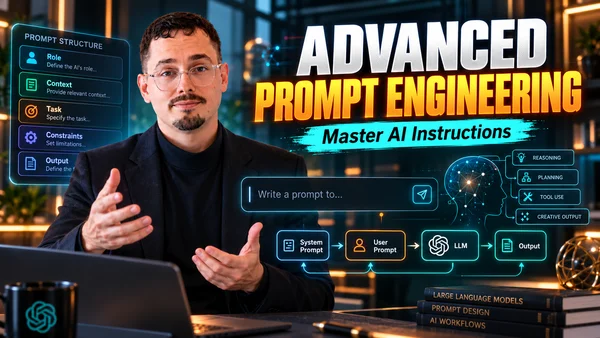
Advanced Prompt Engineering
Go from a rough prompt to a professional method: structure your requests (R-C-T-C-O, RTF, CRAFT, RISEN), master advanced techniques (few-shot, chain of thought, personas, chaining), manage tokens and context, choose the right model at the right cost, control the output and use AI responsibly. You leave with a framework, checklists and a reusable prompt.
PYTHON
Learn the main concepts of PYTHON and get results by writing your first algorithms!