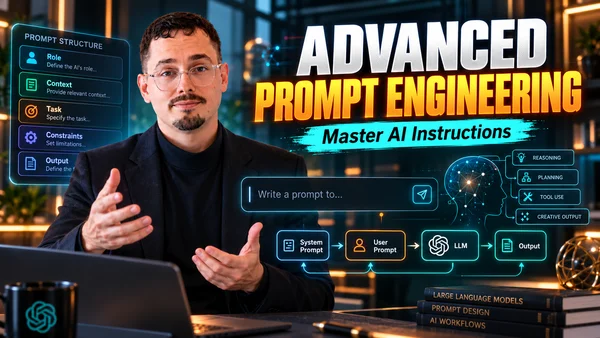
Advanced Prompt Engineering
Design, test and industrialize robust prompts for demanding professional uses.
- Duration
- 21 h · 3 days
- Level
- Advanced
- Format
- On site · Remote · Blended
- Max. group size
- 12 participants
Overview
This program is for those who already master the basics of prompting and want to scale up: advanced reasoning, structured outputs, prompt chaining, tool calls, systematic evaluation, security and cost optimization. It takes an engineering approach: it is not enough to write a good prompt, you measure it, version it and make it reliable so it holds up over time.
Who this program is for
- Advanced generative AI users and AI leads in companies
- Product owners, analysts and consultants who design AI use cases
- Developers and technical profiles integrating LLMs into their products
Prerequisites
- Having completed the Prompt Engineering program or mastering its basics
- Regular use of a generative AI assistant
- Basic knowledge of JSON is a plus
Learning objectives
- Apply advanced reasoning techniques
- Get structured outputs that a program can use
- Design prompt chains for complex tasks
- Measure and compare prompt quality with an evaluation method
- Protect your uses against prompt injection and misuse
- Use tool calls and multimodal inputs
- Optimize cost, latency and model choice
- Version and govern a prompt library
Detailed curriculum
9 modules · 21 h · 3 days
Advanced reasoning and structuring
- Step-by-step reasoning and self-verification
- Decomposing complex problems
- Exploring several paths and consensus
- When reasoning helps… and when it hurts
Compare several reasoning strategies on a business analysis case.
System prompts and structured outputs
- Writing a robust system prompt
- Enforcing an output schema (JSON, tables)
- Validating and repairing outputs
- Handling edge cases
Advanced few-shot and prompt chaining
- Choosing and organizing examples
- Dynamic examples
- Chaining several prompts
- Splitting a process into specialized steps
Turn a complex task into three chained prompts.
Systematically evaluating your prompts
- Building a representative test set
- Evaluation criteria and grids
- LLM-as-a-judge evaluation and its limits
- Comparing prompt versions (A/B tests)
Build a test set, score the outputs and decide which version to deploy.
Robustness and security
- Direct and indirect prompt injection
- Information leakage and workarounds
- Guardrails, filtering and validation
- Hallucinations: detection and reduction
Tool calls and multimodal inputs
- How function calling works
- Describing a tool so it is used correctly
- Images and documents as input
- Limits and best practices
Costs, latency and model choice
- Understanding tokens and pricing
- Reducing prompt size
- Caching and context reuse
- Choosing the right model for the right task
Industrializing: versioning and governance
- Versioning and documenting your prompts
- Organizing a team library
- Tracking quality over time
- Governance and compliance
Capstone project: industrialize a business prompt
- Choosing a real use case
- Design, evaluation and hardening
- Documentation and presentation
Each participant (or pair) delivers an industrialized prompt with its test set and documentation.
Tools and technologies
Teaching methods
- Technical demonstrations and case studies
- Hands-on workshops with test sets
- Group prompt reviews
- Capstone project: industrialize a business prompt
Assessment
- Graded exercises in each module
- Building and evaluating an industrialized prompt
- Oral presentation of the capstone project
Required equipment
- A computer with an internet connection
- Access to at least one AI assistant and, ideally, an API key (provided or personal)
Resources provided
- Course materials and example notebooks
- Test sets and evaluation grids
- System prompt templates
Career outcomes
- Reliable, measurable prompts in production
- An evaluation method reusable by the team
- Foundation for building agents and RAG systems
Related video courses
My video courses that go with this program, to get ready for the training or to review afterwards. Free with an account.